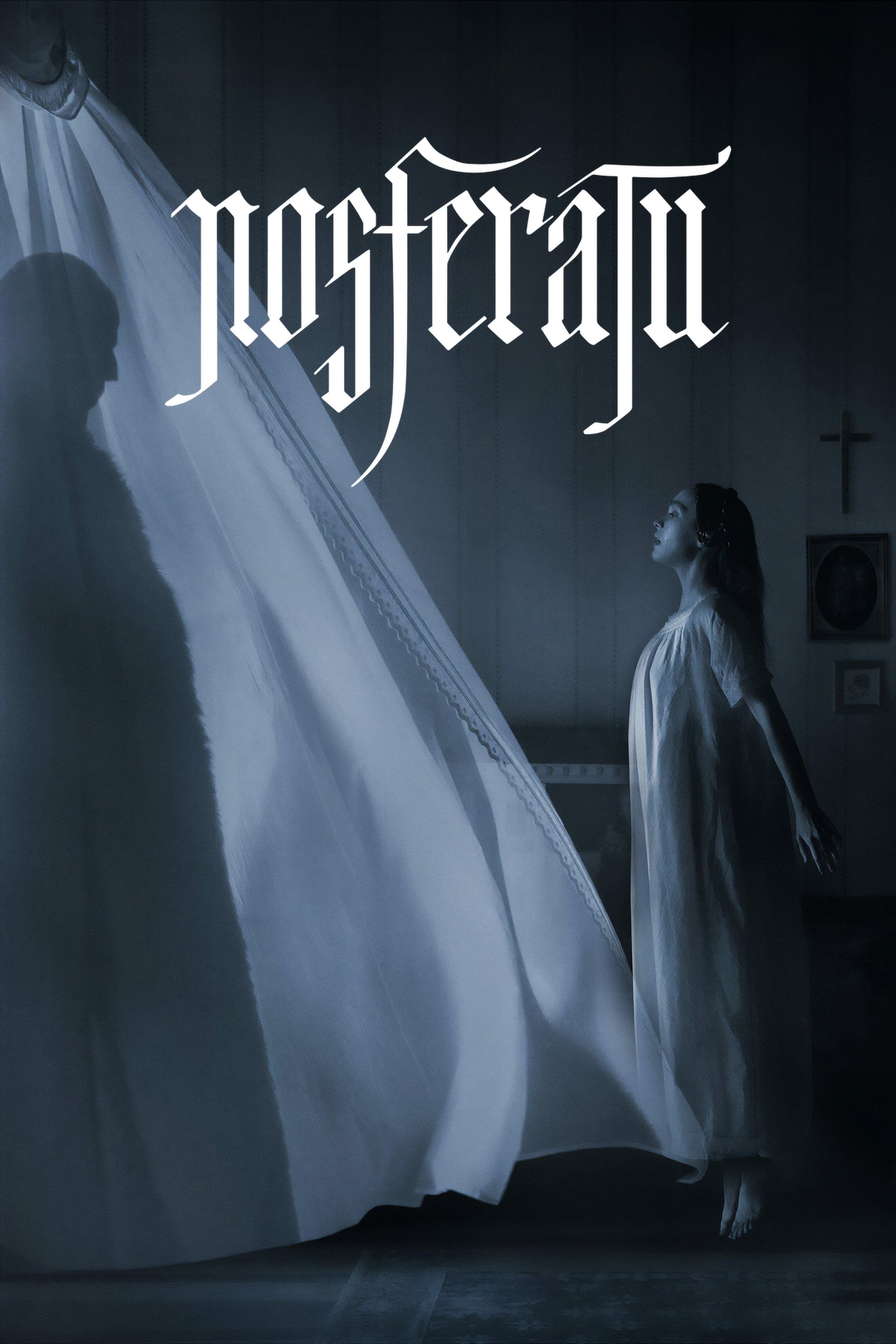
Nosferatu (2024)
Nosferatu (United States: Maiden Voyage Pictures; Studio 8; Birch Hill Road Entertainment, 2024).
Eggers has suffered an association with unsavoury elements since at least The Northman (2022). Sam Knight, in a profile for The New Yorker that was published before that film’s release, takes the time to mention his “hair buzzed close to his scalp on the sides.” It’s tricky to associate yourself with the mythic roots of white culture. Nosferatu is a response to the director’s own public image. The surface of the text can be summarized in the scene where Aaron Taylor-Johnson delivers a ham-fisted speech about how useless women are, and we the audience are meant to feel frustrated and defensive of Lily Rose-Depp. But what motivates the conflict of the film? Count Orlok was in a “living death” in a grave. It is Ellen’s inspiration that sparks him to life, and we are led to believe that she instigated him coyly. The body of the text still contains a masculinist view of sexuality.
Oh, Canada (2024)
Oh, Canada (United States: Foregone Film PSC; Fit Via Vi Film Productions; Lucky 13 Productions; Ottocento Films; SIPUR; Vested Interest, 2024).
A very complicated, elusive structure. My main question coming out of this is whether or not it’s meant to be taken as sincere. Based on Schrader’s recent output, and my understanding of his late aesthetic, it seems like an ironic pastiche…but the music, and those lingering shots of New England are hard to read as anything other than a sincere attempt to make something worth watching. Because otherwise the film has the late-stage severity of many other American filmmakers who spent their careers obsessing over darkness.
La bête (2024)
The Beast (France; Canada: Les Films du Bélier; My New Picture; Sons of Manual; Arte France Cinéma; AMI Paris, 2023).
I just wanted to relax, and knew that this film would hit me over the head with its smug Contemporary Relevance. It does, and its smugness is most evident in the gimmick with the credits. Scan a QR code and you are brought to an extra eight-minute segment. And yet I cannot deny that the film is excellent. So many of my interests are here: the Contemporary, digital life, masculinity, love and sex. Not only that, but it makes Henry James relevant again, and in a way that I think he would have appreciated. The historical setting in this film gives both the epic, long scale that we see in so many of the Master’s work; additionally, it functions as a form of contextualization for the meta-text. Even the stunt casting of Dasha works.
The Brutalist (2025)
The Brutalist (United Kingdom; United States: Brookstreet Pictures; Kaplan Morrison, 2024).
overall i like the film, yes, because the intentional nature of its design really feels like a breath of fresh air. the overture should have been longer imo, but i liked the title design; the literary quality of the overture / intermission / epilogue, and its two parts; i really liked the design of the end credits; brody is giving a pretty typical performance, but it’s good…
Jane Eyre
Charlotte Brontë, Jane Eyre: An Autobiography (1847; repr., Ware, Hertfordshire, England: Wordsworth Classics, 1999).
A masterpiece that taught me so much about writing with those glorious sentences. Wuthering Heights I found to be quite experimental and difficult to follow: Emily has that classic Victorian style of long, winding, clause-heavy sentences, but they’re experimental and abstract whereas Charlotte’s sentences are crystal clear. I suspect, without really knowing, that there’s calculated use of English words based on their Latin/Germanic root. 19th century writing in English is so instructive, just because it may very well have been the height of literacy. I learned new words, but they settle into the lines in a way entirely dissimilar to a Pynchon or DFW, who will often repurpose words from technical fields. Modern/postmodern vocabulary feels ostentatious (non-pejorative). Jane Eyre’s vocabulary is extensive, but natural. The sentences are long, filled with commas, semi-colons and colons, but they read so smoothly. They have the flow of diction in a way that Henry James is allegedly trying to get at, but his end up feeling schizophrenic—they’re extremely difficult to follow (for me). This book is masterfully crafted and characterized: I love how well she understands men. Jane is always perfectly diagnosing the flavours of toxic masculinity embodied by Rochester and St John; and she is able to perfectly manipulate them into calming down. If the book suffers, it’s at the level of plotting.
Code
Charles Petzold, Code: The Hidden Language of Computer Hardware and Software (Redmond, WA: Microsoft Press, 1999).
I got this book because I had the intention of learning C, a “high level assembly language,” and wanted to know how computers work on a more fundamental level. The concept of the book is to proceed historically and build a functioning computer with minimal technology: it could be done with 19th century inventions, it would just be very unwieldy and limited. from there, the text continues to trace the development of technology up until modern computing paradigms. it’s roughly around the invention of transistors that there’s a paradigm shift and the diagrams become too complicated to follow without serious study, which I was not committed to doing. chapters roughly alternate between treating hardware innovations, which I began to skim; and conceptual innovations that were easier to follow.
First You Write a Sentence
Joe Moran, First You Write a Sentence: The Elements of Reading, Writing...and Life (London, England: Penguin Books, 2018).
I picked this book up from the library because I am trying to improve my sentences by studying grammar & syntax. I got about 80 pages in, and although I learned a few things, I have to concur with the other reviewer that the book simply contains too much fluff. the sentences are nice, but my feeling is that the author is so concerned with practicing what he preaches that he has therefore chosen to embed everything in some smooth-rolling narrative. this is a “popular” book whose audience can only be hack writers or children. a serious writer, like myself, lol, will not be interested in wading through all the anecdotes in order to extract a few good lessons: I personally want something much more technical and rigorous, more like a textbook. residents of r/writing may find this book beguiling, but it just made me impatient.
Hunger
Knut Hamsun, Hunger, trans. Robert Bly (New York: Noonday Press, 1998).
It makes a lot of sense that Hamsun (per Wikipedia) thought that the purpose to literature was to explore psychology. This novel is a spot-on, completely three-dimensional portrait of narcissism and mental illness more generally. The story opens up with the narrator wanting to write a three-volume takedown of Kant (presumably to be published in a popular journal): we have the over-represented aspect of narcissism as excessive self-love. However, a more constant refrain throughout the book is the narrator constantly brow-beating and hating himself. These are, imo, more fundamental aspects of narcissism, and their recurrence shows how deeply the author understands his character (as he should: per the afterword, this book condenses 10 years of lived experience).